
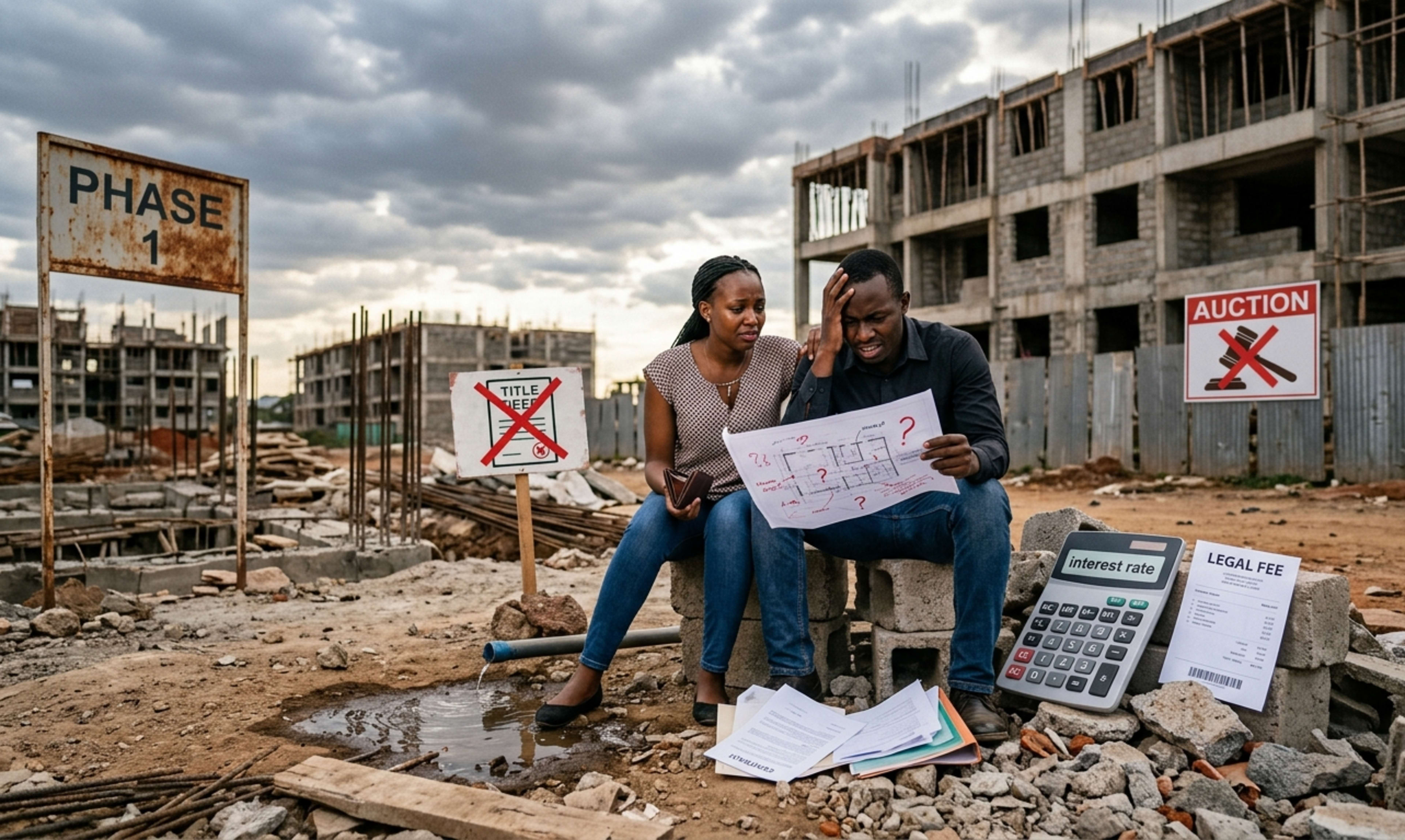
The 5 Property Investment Mistakes Kenyan First-Time Buyers Always Make
Over 60% of first-time Nairobi buyers overpay, choose the wrong location, or get blindsided by costs they never saw coming. These aren't edge cases — they're the pattern. Here's how to break it.

Clinton Openda
May 12, 2026
In Kenya's property market, the first mistake doesn't happen at the Land Registry. It happens in your head — the moment you fall in love with a house before you understand what it actually costs you.
Over 60% of first-time buyers in Nairobi either overpay, buy in the wrong area for their budget, or discover hidden costs they didn't budget for — according to industry surveys and agent reports from 2023–2024. These aren't rare horror stories. They're the norm. And they're happening to people who did their research, saved diligently, and thought they were ready.
Here are the five mistakes — and how to avoid every single one of them.
Mistake 1: Falling in love with the listing price instead of the total acquisition cost
A two-bedroom apartment in Kilimani listed at KES 8.5 million sounds clear-cut. It isn't. What nobody tells first-time buyers upfront is that the sticker price is just the starting gun.
By the time you factor in stamp duty (4% on residential property above KES 4M — that's KES 340,000 gone immediately), legal fees (typically 1–2% of purchase price), valuation fees, bank processing fees, and a mandatory survey, you're looking at an additional 8–12% on top of the listed price. On that KES 8.5M flat, you've just spent KES 9.4M to KES 9.5M before you've touched a light switch.
For off-plan purchases — which dominate Nairobi's mid-market — add a further 16% VAT on developer margins where applicable, plus sinking fund contributions that kick in before occupation.
The fix: Always calculate your "true cost of acquisition" before viewing. Not after. Use this as your baseline: Listed Price × 1.12 = your real budget minimum.
Search apartments with transparent pricing on Qimani →Mistake 2: Buying in a prestige area when a neighbouring suburb offers better value and faster appreciation
Westlands and Kilimani carry postcode prestige. They also carry postcode premiums that have compressed rental yields to between 4–5.5% gross annually — barely above inflation. Yet buyers consistently stretch their budgets to land an address they can mention at dinner parties.
Meanwhile, suburbs like Ruaka (average price per sqm: KES 65,000–80,000 versus Kilimani's KES 120,000–145,000), Athi River, and pockets of Kitengela have posted annual appreciation rates of 8–12% over the last three years, driven by infrastructure investment and diaspora demand.
The Nairobi Expressway changed the commute equation fundamentally. What was a 90-minute crawl to Westlands from Ruaka is now 20 minutes on a toll road. The buyer who understood this in 2021 has watched their KES 5M townhouse grow to KES 6.8M. The buyer who bought a studio in Kilimani for KES 5.5M is holding flat.
The fix: Look at infrastructure first. Where is the next road, rail, or commercial corridor going? Property follows infrastructure. Always.
See what your budget gets you in Ruaka →Mistake 3: Using a developer's recommended lawyer
This one is uncomfortable to say out loud, but it needs to be said.
When a developer hands you a list of "recommended" advocates during the sales process, that list is not a neutral service. In many cases, those advocates have a working relationship with the developer — repeat business, referral arrangements, or simply a shared interest in closing the transaction quickly. Their loyalty is structurally divided.
Buyers in Kenya have lost deposits, purchased units with undisclosed encumbrances, and signed sale agreements with clauses that waive their rights under the Law of Contract Act — because they used the advocate the sales agent handed them a business card for.
An independent advocate conducting proper due diligence will search the title at the Lands Registry, confirm the developer holds a valid building permit, check whether the land is leasehold or freehold (and how many years remain), and confirm no pending litigation. This costs between KES 30,000–80,000 for a competent firm. It is the best money you will spend.
The fix: Find your own lawyer. Ask a friend, not the salesperson.
Mistake 4: Ignoring the service charge — the bill that never stops
Apartment buyers fixate on the mortgage payment. They forget that there is a second monthly payment that will follow them for the entire life of ownership: the service charge.
In Nairobi's gated apartment complexes and managed estates, service charges run between KES 8,000 and KES 35,000 per month depending on amenities, management quality, and size of the estate. High-end complexes in Lavington or Runda can go higher. These cover security, maintenance, common area utilities, lift servicing, generator fuel, and management fees.
What many buyers discover too late is that service charges are unregulated, non-negotiable, and can be increased by the management company with limited tenant recourse. A poorly managed estate with deferred maintenance can see charges spike sharply to fund catch-up repairs.
Before signing anything, request the last 24 months of service charge statements and the management company's audited accounts. If they won't provide them, treat it as a red flag — not a negotiating point.
The fix: Calculate your true monthly cost as: Mortgage Repayment + Service Charge + Utilities. That is your real affordability test.
Browse managed apartments on Qimani — service charges listed where available →Mistake 5: Buying off-plan from a developer without checking project completion history
Off-plan purchases dominate the Nairobi market for a simple reason: developers use them to finance construction. Payment plans of 10–20% deposit with the balance spread over 12–36 months are genuinely attractive when compared to a mortgage.
The risk is equally real. Between 2018 and 2024, Kenya has seen multiple high-profile off-plan stalls — projects that absorbed millions of shillings in deposits and either delivered years late or collapsed entirely. Buyers in affected schemes have spent years in civil litigation trying to recover funds, often settling for cents on the shilling.
Red flags that experienced investors watch for:
- Developer has no completed project you can physically inspect
- No project escrow account (funds should be held by a third party, not the developer's operating account)
- No NCA (National Construction Authority) registration for the contractor
- Sales office is temporary or off-site, not at the actual project location
- Completion timelines stated verbally but not contractually guaranteed with penalty clauses
The most important question you can ask a developer is simple: "Can you take me to a project you completed in the last three years so I can speak to residents?" Watch the reaction carefully.
The fix: Only buy off-plan from developers with a verifiable completion track record. Use escrow. Have your independent advocate review the sale agreement for penalty clauses if delivery is delayed.
Search verified property listings across Kenya on Qimani →The bottom line
The Kenyan property market rewards buyers who are analytically cold about the biggest financial decision of their lives. That doesn't mean being emotionally detached — it means separating the excitement of ownership from the discipline of acquisition.
Every one of the five mistakes above has a common root: speed. Buyers rush because they're afraid someone else will take the property. Developers and agents exploit that fear. Slow down. The right property at the right price is not the one that closes fastest — it's the one that holds its value, delivers rental yield if needed, and doesn't collapse your finances with hidden costs six months in.
You have more leverage than you think. Use it.
Start your search on Qimani — Kenya's leading property marketplace →