
Title Deed Fraud in Kenya: How to Verify Any Property in 10 Minutes
Title fraud doesn't only happen to careless buyers. It happens to diligent people who trusted a process they didn't fully understand.

Clinton Openda
Kenya Property News
March 26, 2026
5 min read
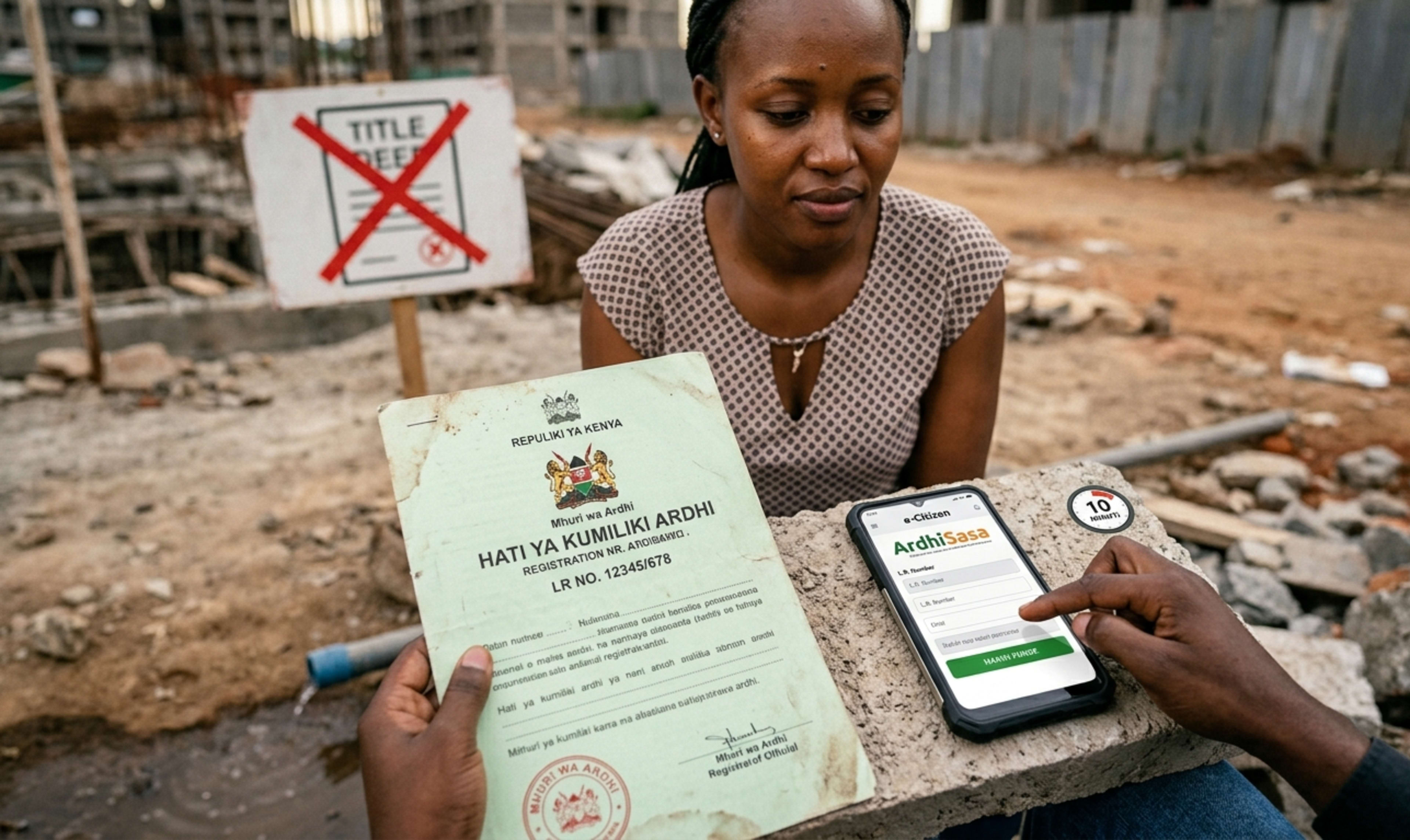
Someone in Kenya is registering a fraudulent title deed right now. The property may be yours — and you won't know until you try to sell it.
Title deed fraud is not rare. It is not sophisticated. And it does not only happen to careless buyers. It happens to diligent, educated people who trusted a process they didn't fully understand. In 2023 alone, the Environment and Land Court handled thousands of disputed title cases — many involving outright forgery, double allocation, or fraudulent transfers conducted while the legitimate owner was completely unaware.
The good news: a basic but powerful verification takes under 10 minutes and costs almost nothing. Here is exactly how to do it.
Step 1: Get the title number and confirm the land reference format
Before anything else, the seller or developer must give you the title number — not the plot number, not the estate name, not the developer's internal reference. The actual title number as it appears on the document.
Kenyan title numbers follow specific formats depending on the registration system:
- Freehold (absolute proprietorship): e.g. Nairobi/Block 123/456
- Leasehold: e.g. L.R. No. 209/1234
- Land Reference (older system): e.g. Land Ref. 1234/56
If a seller hesitates to give you this number, treat the hesitation as the answer. There is no legitimate reason to withhold it.
Step 2: Run an official search at the Lands Registry — in person or online
An official land search confirms who is currently registered as the proprietor, whether there are any encumbrances, caveats, or cautions on the title, and whether the land is subject to any court orders.
In person: Visit the relevant county Lands Registry (Nairobi is at Ardhi House on Ngong Road). Submit a search request form with the title number and pay the search fee — currently KES 500. Results are typically ready same day or within 24 hours.
Online: The Ministry of Lands runs the Ardhisasa platform at ardhisasa.lands.go.ke — currently covering Nairobi and progressively expanding to other counties. You can conduct a title search, view the registered owner, and check for encumbrances from your phone. This is the 10-minute method. Create an account, enter the title number, and the system returns the registration details instantly.
Note: Ardhisasa coverage is still incomplete for some older titles and rural counties. If your search returns no result, it does not mean the title is invalid — it may simply not yet be migrated. In that case, conduct the in-person search.
Step 3: Confirm the registered owner matches the person selling to you
This is where most fraud is caught — and where most buyers don't look carefully enough.
The search result will show the registered proprietor's name exactly as it appears on the title. That name must match, precisely, the name on the seller's national ID or passport. Not approximately. Not "it's the same person, different spelling." Exactly.
Common fraud patterns to watch for:
- The registered owner is deceased and a relative is selling without probate having been completed — the title has not been legally transmitted to them yet, and they have no right to sell
- The registered owner is a company that has since been deregistered — a deregistered company cannot transact
- The person presenting as the owner is using a forged ID matching the registered name — ask for multiple forms of ID and cross-reference the ID number with the IPRS (Integrated Population Registration System) via eCitizen
The agent assures you they've done this check themselves— verify this yourself, always
Step 4: Check for cautions, caveats, and encumbrances
A clean title is not just one where the name matches. It is one with no registered interests that could affect your ownership.
The search result will show:
- Charges: a bank or lender has a registered interest — meaning the property is mortgaged. The charge must be discharged before or at the point of transfer. If it isn't, the lender's interest survives the sale and can lead to repossession even after you've paid.
- Cautions: a third party has notified the Registry that they have an interest in the land. No transactions can be registered until the caution is lifted. This could be a family dispute, a pending court case, or a previous buyer who paid a deposit and never got a transfer.
- Caveats: similar to cautions but typically more formal — often placed by courts or government bodies.
- Restrictions: conditions on how the land can be used or transferred, sometimes placed by developers in managed estates.
Any of these on a title is a stop sign, not a speed bump. Do not proceed until your independent advocate has confirmed in writing that the encumbrance is resolved or does not affect your purchase.
Step 5: Verify the physical boundaries match the title document
Fraud is not always on paper. Sometimes the title is genuine — but it describes a different piece of land from the one being shown to you.
This happens more than buyers expect, particularly in subdivided plots and peri-urban areas where boundary markers have been moved, removed, or were never properly placed. A seller shows you a desirable quarter-acre. The title they hand you covers a quarter-acre — but 200 metres away, adjacent to a quarry.
The fix is a physical survey by a registered surveyor, who will peg the boundaries as described in the Registry of Survey and confirm they match the land on the ground. This costs between KES 15,000 and KES 50,000 depending on size and location. For land purchases — as opposed to apartments with strata titles — this step is not optional.
Step 6: Cross-check with the National Construction Authority for apartments
If you are buying an apartment — off-plan or completed — the building itself must have been constructed under a valid NCA-registered contractor and with the relevant county government approvals.
Verify:
- Building approval/permit: issued by the county government before construction began. Request the permit number and verify it with the county's planning department.
- Occupation certificate: issued after construction is complete and inspected. Without this, the building is technically not approved for occupation — and your apartment may not be insurable or mortgageable by a future buyer.
- NCA contractor registration: search the contractor's registration at nca.go.ke. An unregistered contractor on a project is a liability risk you inherit as an owner.
The 10-minute version: what you can do right now, from your phone
If you are in an active property search and want the fastest possible first-pass check before investing more time:
- Ask the seller or agent for the title number — full format, exactly as it appears on the document
- Go to ardhisasa.lands.go.ke on your phone and create an account (takes 3 minutes with your national ID)
- Run a title search — confirm the registered owner's name and check for encumbrances
- Cross-reference the registered owner's name against their ID on eCitizen's IPRS checker
- If anything doesn't match, or if the seller won't provide the title number: walk away.
This does not replace a full legal due diligence. It is a first filter that eliminates obvious fraud before you spend money on advocates, valuers, and surveys. Use it on every property, every time — even when the agent seems trustworthy, the estate looks legitimate, and the price feels right.
Especially then.
What to do if something comes back wrong
If your search reveals a discrepancy — a name mismatch, an unexpected encumbrance, a caution you weren't told about — do not confront the seller directly before speaking to an advocate. Some fraud is deliberate. Some is the seller being genuinely unaware of a family dispute or undisclosed charge. Either way, you need legal advice before your next move.
Report suspected title fraud to:
- The Lands Registry — they can place a caution to freeze transactions while the matter is investigated
- The Directorate of Criminal Investigations (DCI) — title deed fraud is a criminal offence under the Land Registration Act
- The Law Society of Kenya — if an advocate is involved in the fraud
If you have already paid a deposit on a fraudulent title, do not pay any further amounts under any circumstances. Seek an emergency injunction through the Environment and Land Court to freeze further transactions on the property while you pursue recovery.
Search verified property listings across Kenya on Qimani →